
Microinnova, in collaboration with the Austrian Center of Industrial Biotechnology (ACIB), has developed an innovative solution for overcoming the challenges of O₂-dependent continuous biotransformation in fine chemical manufacturing. Traditional batch technology, limited by thermodynamic and kinetic constraints, struggles to efficiently supply oxygen to enzymatic reactions, creating bottlenecks that hinder conversion efficiency.
By submitting your information, you’re giving us permission to email you. You may unsubscribe at any time. We do not sell your data.
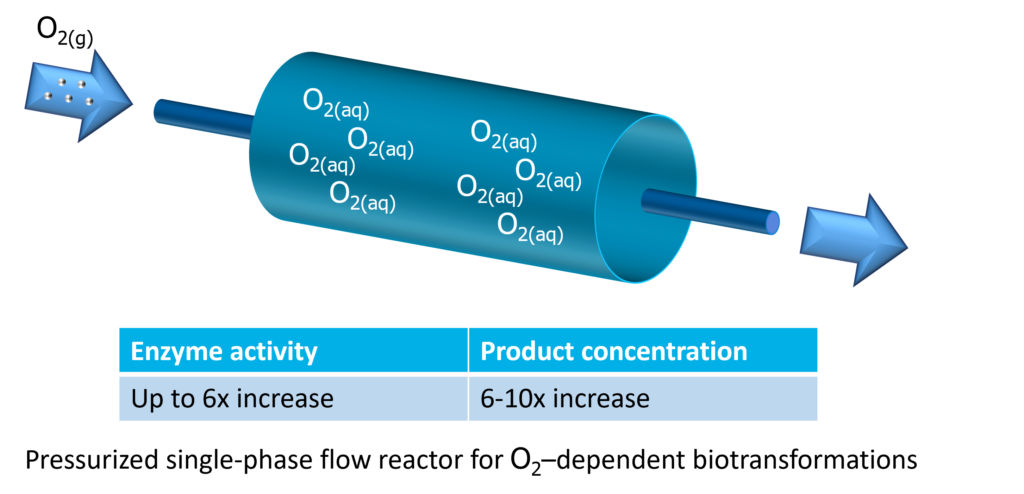
By applying process intensification through continuous flow technology, these challenges were resolved. A continuous flow reactor capable of operating at pressures of up to 34 bars enabled biotransformations to occur in a single liquid phase. This pressurized environment significantly increased the amount of dissolved oxygen, boosting enzyme activity and product concentration. For example, enzyme activity for glucose oxidase increased by a factor of 2.5 at 10 bars, while amino acid oxidase activity increased by a factor of 6. Additionally, product concentrations were 6 to 10 times higher at 34 bars compared to atmospheric pressure.
These results were demonstrated using both soluble enzymes in liquid flow and immobilized enzymes in packed bed reactors. The ability to operate at elevated pressures, achieving a 34 to 170-fold increase in dissolved oxygen, highlights the potential of continuous flow reactors to transform the efficiency of O₂-dependent enzymatic processes. Microinnova’s approach provides a powerful engineering tool to overcome the inherent limitations of batch processing, offering new possibilities for fine chemical and biotechnological manufacturing.
To provide you with an optimised experience, we use technologies such as cookies to store and/or access device information. If you consent to these technologies, we may process data such as browsing behaviour or unique IDs on this website. If you do not give or withdraw your consent, certain features and functions may be impaired.