
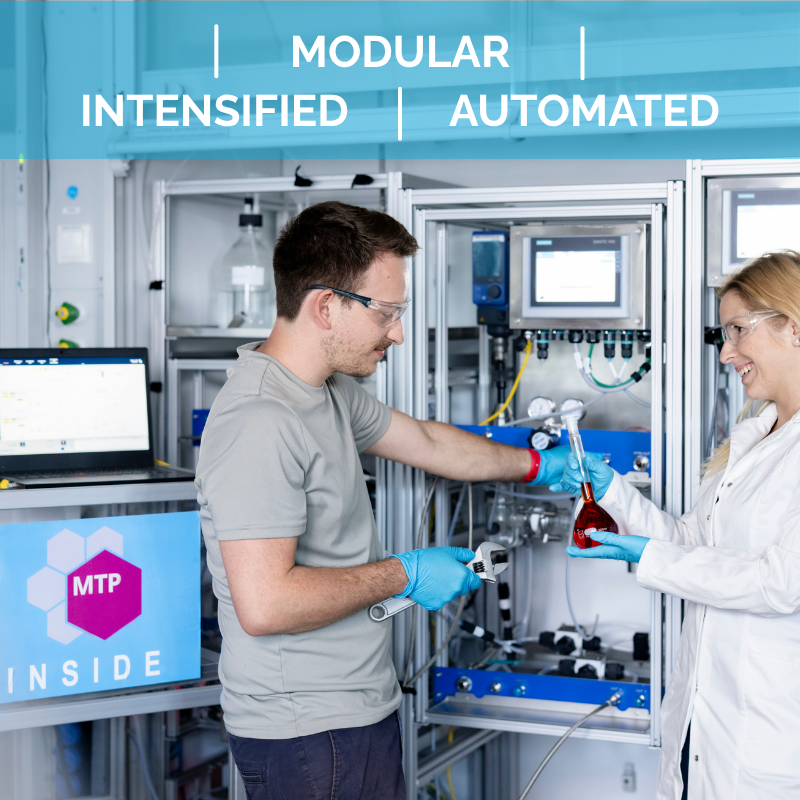
The traditional process industry stands at a critical crossroads. Faced with tightening regulatory pressures, shifting global markets, and demanding cost structures, chemical and pharmaceutical sectors can no longer rely on legacy batch operations and static infrastructure. Stagnation is no longer a safe harbor; companies that fail to modernize risk obsolescence.
Transforming this vital sector requires focusing innovation on three core pillars: modularization, dark factories, and process intensification.
In a competitive global landscape, speed wins. Building custom, monolithic plants takes years and ties up massive capital before a single commercial batch is ever produced. Modularization changes the game by breaking entire chemical processes down into pre-engineered, standardized Process Equipment Assemblies (PEAs).
Utilizing standardized automation frameworks like Module Type Package (MTP), these modular units act as plug-and-play components that can be rapidly pre-tested, shipped, and assembled on-site. This approach slashes time-to-market dramatically, often cutting project realization windows in half while providing unprecedented manufacturing flexibility. Companies can scale capacity up or down dynamically, reconfigure lines for new products, and respond to market demands in weeks instead of years.
The ultimate frontier of efficiency is the dark factory, a manufacturing environment operating with minimal human intervention, where lighting and climate control for personnel are no longer necessary. Driven by advanced automation, intelligent process control, and real-time data analytics, autonomous plants run continuously and safely.
For the chemical and pharmaceutical industries, transitioning toward dark factories removes human error from hazardous handling, maximizes uptime, and stabilizes output quality. By pairing continuous flow and modular design with smart, lights-out digital architectures, manufacturers achieve a level of precision and resilience that manual facilities simply cannot match.
Conventional chemical engineering often relies on massive batch vessels where heat transfer and mixing limitations dictate slow reaction rates. Process intensification shatters these paradigms by replacing large, inefficient equipment with compact, highly reactive systems—chiefly through continuous flow chemistry and microreactor technology.
By drastically shrinking the reaction volume, process intensification improves mass and heat transfer, allowing hazardous or highly exothermic reactions to run safely under extreme conditions. This approach minimizes energy consumption, cuts waste streams, and delivers tighter control over product quality. Moving from multi-ton batch tanks to compact, continuous footprint setups turns safety risks and high operational overhead into streamlined, highly efficient production cycles.
The mandate for the process industry is clear. Survival depends on breaking free from legacy inefficiencies and embracing continuous development, modular agility, and autonomous execution. Innovating across these three dimensions is the only path forward to secure a competitive, sustainable future.
To provide you with an optimised experience, we use technologies such as cookies to store and/or access device information. If you consent to these technologies, we may process data such as browsing behaviour or unique IDs on this website. If you do not give or withdraw your consent, certain features and functions may be impaired.